Observe by default
Evidence collection does not grant mutation authority.
Turn workflow failures into clear incidents, controlled decisions, and recoverable responses on infrastructure you own.
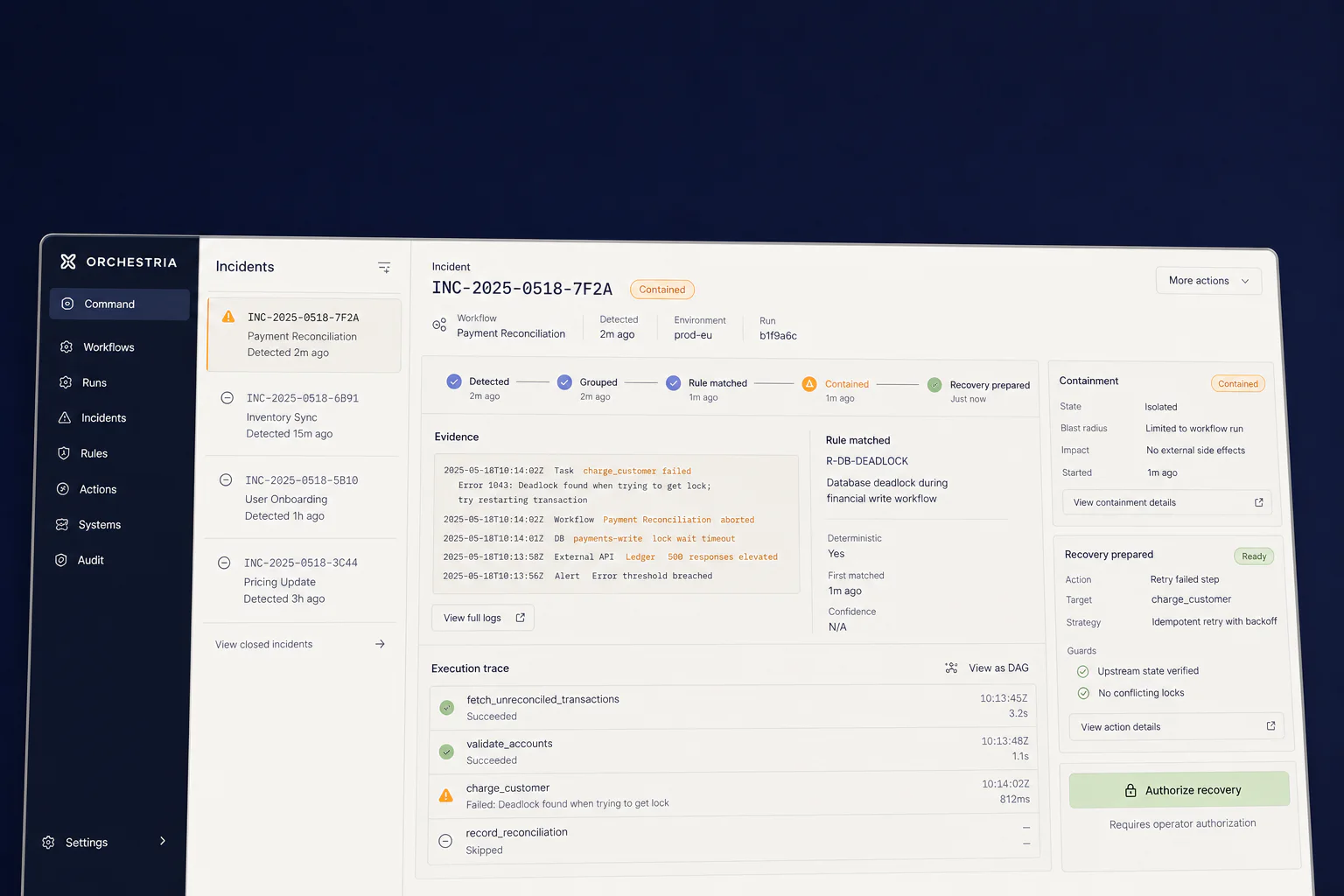
One operating model turns scattered execution evidence into an incident, a deliberate decision, and an auditable path back to healthy operation.
Self-hosted by design
Keep operational evidence, workflow versions, recovery policy, and audit history inside infrastructure your team controls.
Orchestria adds operational control without becoming the place where your workflows must run.
Low-risk, deterministic actions may proceed by policy. Higher-risk changes pause with evidence and a recoverable plan ready for review.
Evidence collection does not grant mutation authority.
Known failures stay deterministic and explainable.
Every recovery starts from a recoverable state.
Higher-impact actions pause for explicit approval.
No. Orchestria sits beside workflow platforms and adds monitoring, incident handling, policy, recovery controls, versions, and audit history.
Teams running business-critical workflows that need clearer failure handling, controlled recovery, and an auditable operating model without handing their infrastructure to another platform.
n8n is the first integration target. We are also learning from teams using Temporal, Prefect, Airflow, Kestra, and other workflow systems so the reliability model is not tied to one engine.
Observation is the default. Known, low-risk actions may be permitted by explicit policy; higher-risk recovery remains authorized, versioned, and recoverable.
Hosted Orchestria is the default early-access path. A self-hosted deployment remains available for teams with compliance, private-network, or infrastructure-ownership requirements.
No. Deterministic classification and policy come first. Claude is the first planned provider for ambiguous diagnosis during early access, with redacted inputs, structured output validation, confidence controls, and human review. This capability is not yet publicly available.
We securely store your environment brief, review it for early-access fit, and contact you at the email address you provide as cohorts open. Joining does not create an account or subscribe you to unrelated marketing.
Waitlist submissions are stored in Cloudflare D1 and used only to evaluate and coordinate Orchestria early access. We do not sell the information or store raw IP addresses with your submission.
Early access
Request early access and help shape reliability around real workflows, failure modes, and infrastructure constraints.